

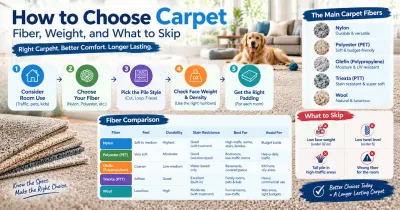
Blog · Carpet Education
Best Carpet for High Traffic Areas: Specs, Fibers, and Picks
Choosing the best carpet for high traffic areas is less about brand names and more about three measurable specs most buyers never check. Homeowners replace hallway and stair carpet every four to five years not because carpet wears out that fast by nature but because the wrong product went into the wrong location. A carpet rated for a bedroom will fail in a main hallway within two years. The right carpet in the same spot can last fifteen.
Published October 12, 202612 min read
This article gives you the exact numbers, fiber picks, and construction choices to get it right the first time.
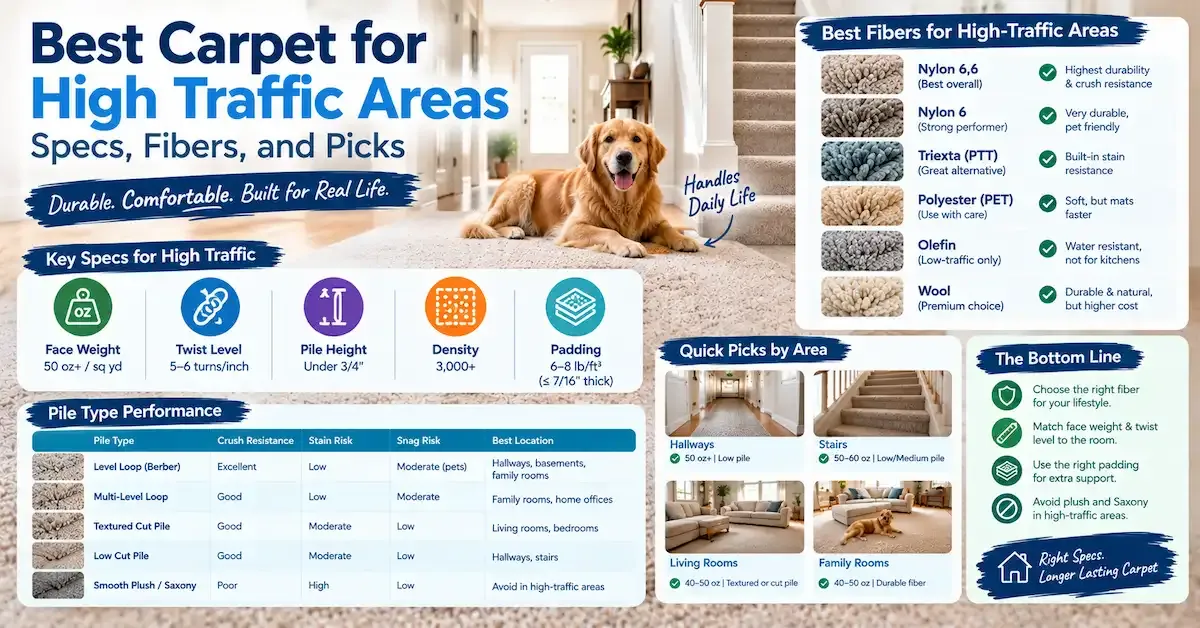
For high traffic areas, choose nylon or triexta fiber with a face weight of 50 oz or above, a twist level of 5 to 6 turns per inch minimum, and a low to medium pile height. Loop pile and textured cut pile outperform smooth plush surfaces in heavy use. Pair with dense, firm padding no thicker than 7/16 inch.
The Specs That Separate High Traffic Carpet From Regular Carpet
The best carpet for high traffic areas is defined by three specs working together, not by fiber alone.
High Traffic Carpet Specs — Minimum Recommendations
| Spec | Minimum for High Traffic | Why It Matters |
|---|---|---|
| Face Weight | 50 oz per square yard | More fiber per yard means more material absorbing wear before backing shows |
| Twist Level | 5 to 6 turns per inch | Tighter twist holds fiber shape under repeated compression |
| Pile Height | Under 3/4 inch | Shorter fibers resist matting and crushing better than tall pile |
| Density | 3,000 or above (using standard formula) | Tightly packed fibers recover faster after foot traffic |
| Padding Density | 6 to 8 lb per cubic foot | Firm pad reduces subfloor impact stress on fiber roots |
Face weight without twist level means nothing. A 60 oz carpet with a twist level of 3 turns per inch will mat flat faster than a 45 oz carpet with a twist level of 6 and proper heat-setting. These specs work as a system. Check all of them before buying.
Which Fiber Holds Up Best Under Heavy Use?
Fiber choice is the foundation of any high traffic carpet decision. Here is a practical verdict table for real buying decisions.
Carpet Fiber Performance in High-Traffic Applications
| Fiber | Crush Resistance | Stain Resistance | Cost Range | High Traffic Verdict |
|---|---|---|---|---|
| Nylon 6,6 | Highest | Good (topical coating) | $3 to $7.50/sqft | Best overall choice |
| Nylon 6 | High | Good | $2.50 to $6/sqft | Strong performer, slightly below 6,6 |
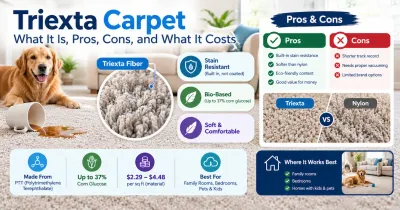
| Triexta (PTT) | Good | Excellent (built-in) | $2.29 to $4.48/sqft | Strong alternative to nylon |
| Polyester (PET) | Low to moderate | Good (solution-dyed) | $1 to $4/sqft | Avoid in true high-traffic locations |
| Olefin | Low | Water-based only | $1 to $2/sqft | Basements and low-traffic only |
| Wool | High | Moderate | $5 to $15/sqft | Excellent but expensive and moisture-sensitive |
Nylon 6,6 remains the industry standard for high traffic carpet. The 6,6 designation refers to the molecular structure of the polymer — it produces a denser, more resilient fiber than standard Nylon 6. Solution-dyed nylon adds color permanently into the fiber during manufacturing rather than applying it afterward, which means color holds under heavy cleaning without fading.
Triexta is the strongest challenger. Its built-in stain resistance does not rely on a topical coating that wears off over time, which makes it a particularly good fit for family homes where spills and pet accidents are part of daily life.
Is Loop Pile or Cut Pile Better for High-Traffic Areas?
Both pile constructions can work in high traffic areas. The right choice depends on the specific location.
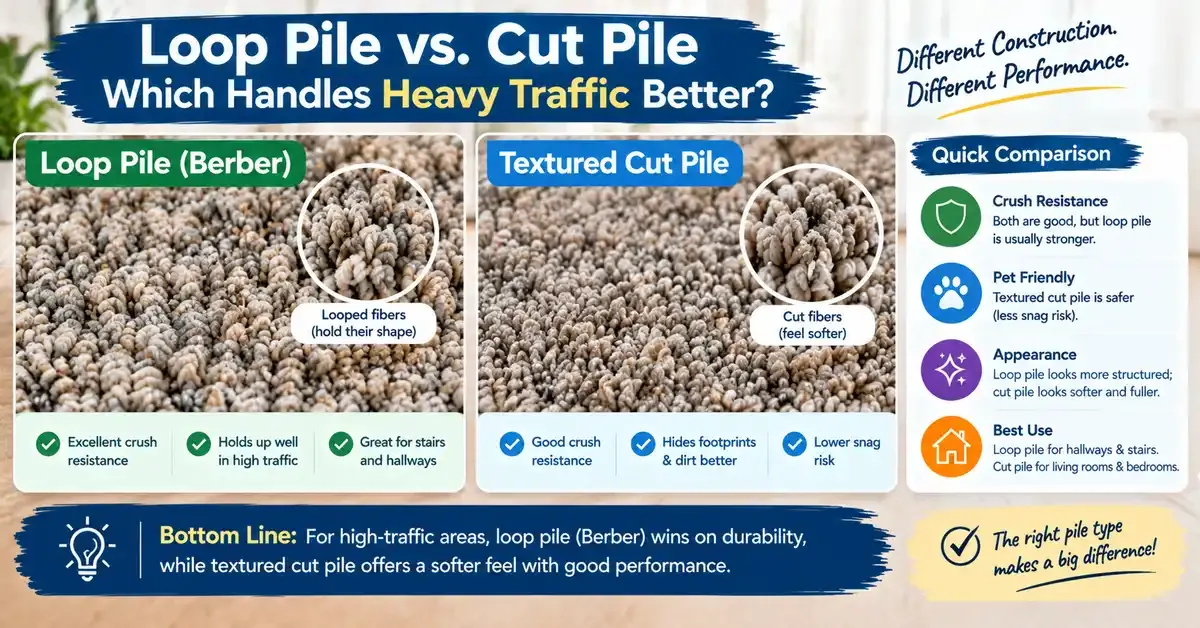
Pile Type Performance for High-Traffic Locations
| Pile Type | Crush Resistance | Stain Risk | Snag Risk | Best High-Traffic Location |
|---|---|---|---|---|
| Level Loop (Berber) | Excellent | Low | Moderate (pets) | Hallways, basements, family rooms |
| Multi-Level Loop | Good | Low | Moderate | Family rooms, home offices |
| Textured Cut Pile | Good | Moderate | Low | Living rooms, bedrooms with heavy use |
| Low Cut Pile | Good | Moderate | Low | Hallways, stairs (with right specs) |
| Smooth Plush/Saxony | Poor | High | Low | Avoid in high-traffic locations |
Level loop carpet — commonly called Berber — performs well in high traffic areas because the looped construction resists compression. Foot traffic pushes down on a loop and the loop springs back. A cut fiber has no such recovery mechanism once it begins to crush.
The trade-off with loop pile in high traffic homes with pets is snag risk. A pet claw catching a loop can unravel an entire row. For pet households, textured cut pile or low cut pile with high twist level is the safer long-term choice.
Smooth plush and Saxony carpets belong in bedrooms. In hallways or family rooms they show traffic lanes and footprints within months.
What Is the Best Carpet for Stairs?
Stairs are the single highest wear point in any carpeted home. Every step concentrates foot traffic on a narrow band of fiber at the nose of each tread.
For stairs specifically, these are the minimum specs that hold up:
- ✓
Face weight: 50 oz minimum, 60 oz preferred
- ✓
Twist level: 6 turns per inch or above
- ✓
Pile height: Under 3/4 inch — shorter is better on stairs
- ✓
Pile type: Low cut pile or textured cut pile only
Avoid loop pile on stairs entirely. A snag from a shoe edge or pet claw on a stair nose can pull an entire loop row loose, and stair carpet is expensive and difficult to repair cleanly.
A homeowner who installs a 40 oz smooth Saxony on their main staircase will see visible wear lines on every tread nose within 18 months. The same staircase with a 55 oz, tightly twisted nylon in a textured cut pile construction can look good at the ten-year mark with proper maintenance.
Runner vs wall-to-wall on stairs is a practical question too. A runner leaves hardwood exposed on both sides and requires secure fastening at every tread. Wall-to-wall stair carpet with proper tackless strip installation holds more firmly under daily use and eliminates edge fraying risk.
Heavy duty carpet on stairs is not a luxury — it is the only specification that makes economic sense given the wear rate of that location.
What Color Carpet Hides Dirt Best in High-Traffic Rooms?
Color choice in high traffic areas is a functional decision, not just an aesthetic one.
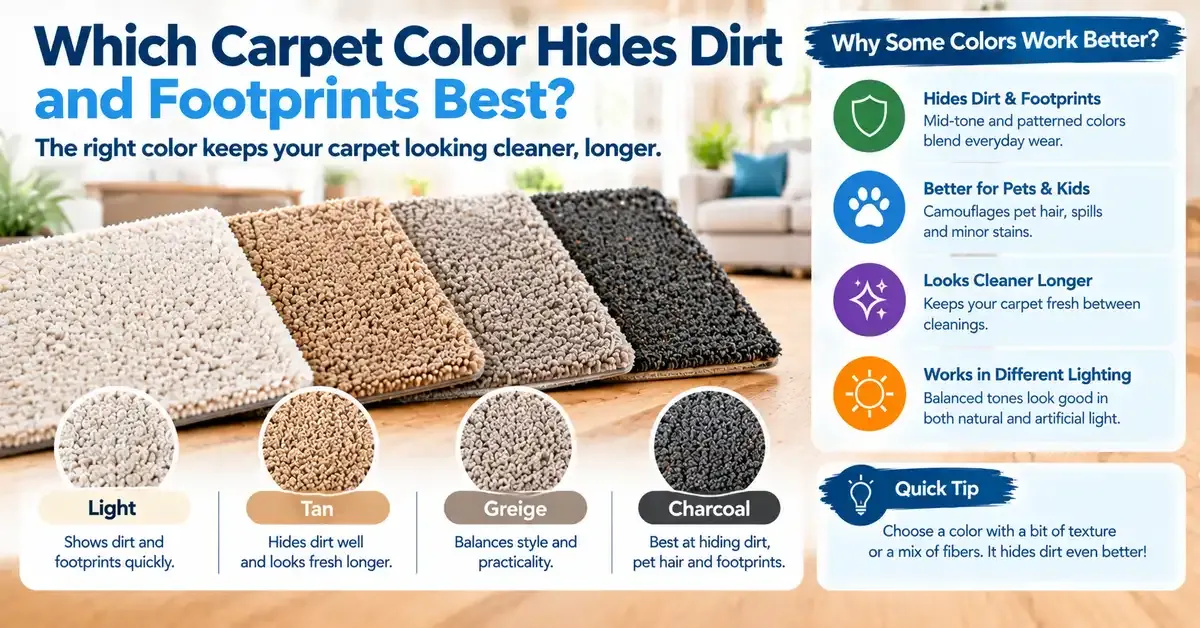
Carpet Color vs High-Traffic Performance
| Color Range | Dirt Visibility | Footprint Visibility | Pet Hair Visibility | Practical Rating |
|---|---|---|---|---|
| Light (cream, white, pale gray) | High | High | High | Avoid in high-traffic rooms |
| Mid-tone (tan, greige, warm gray) | Low | Low to moderate | Low to moderate | Best for high-traffic |
| Dark (charcoal, navy, dark brown) | Moderate (shows dust) | Low | High (light hair) | Mixed results |
| Pattern or flecked texture | Lowest | Lowest | Lowest | Best overall for high-traffic |
Mid-tone colors in the tan, greige, and warm gray range outperform both very light and very dark options in high traffic settings. Very dark carpet shows dust and light pet hair constantly. Very light carpet shows every footprint and spill immediately.
Pattern and flecked texture — common in Berber and commercial-grade carpets — hide everyday soil, debris, and wear patterns better than any solid color. This is not a coincidence. Commercial carpet designers build pattern into products specifically to extend the appearance of cleanliness between cleanings.
For a main hallway or family room, a mid-tone textured or flecked carpet will look cleaner longer with less maintenance than any solid color at either extreme.
How Do You Stop High Traffic Carpet From Matting Flat?
Carpet matting in high traffic areas has one primary cause: fiber that was not twisted tightly enough or not properly heat-set during manufacturing.
When carpet fiber is heat-set, the twist is locked into the yarn permanently. Without heat-setting, foot traffic gradually unwinds the twist, and the fiber splays open and lies flat. Once carpet mats, it does not recover.
Two carpets can look identical in a showroom and perform completely differently at the three-year mark. If one has a twist level of 3.5 turns per inch and the other has 6 turns per inch with heat-setting, the first will show permanent matting in high-use areas and the second will still hold its texture. The showroom feel tells you nothing about this difference.
After installation, three practices slow matting in high traffic areas:
Regular vacuuming with a quality upright vacuum removes the grit particles that cut fiber at the base and accelerate crushing. Vacuuming high-traffic areas three to four times per week is more effective than one deep vacuum per week.
Rotating furniture periodically prevents permanent compression patterns from forming in fixed spots adjacent to high-traffic paths.
Professional hot water extraction cleaning every 6 to 12 months removes embedded grit that vacuum suction cannot reach. That grit acts like sandpaper against fiber roots with every footstep.
What High Traffic Areas Do to Carpet Over Time
These facts explain why fiber and spec selection matter more in busy areas than anywhere else in the home.
The Carpet and Rug Institute traffic classification system rates carpet from light residential through heavy commercial. Most standard residential carpet products are rated for moderate residential traffic — not the heavy daily use a main hallway or family staircase actually receives. Buying to the right traffic rating matters.
According to the World Floor Covering Association, proper padding under high traffic carpet reduces subfloor impact stress by up to 30%, directly extending fiber life in the most heavily used areas of the home. Padding is not optional in a high-traffic installation.
Industry manufacturing data from major carpet producers including Shaw Floors indicates that carpet with twist level below 4 turns per inch loses up to 40% of its original texture appearance within two years in high-traffic settings. Twist level is the single most predictive spec for long-term appearance retention.
The IICRC recommends professional carpet cleaning every 6 to 12 months for high-traffic areas — twice the standard recommendation for low-traffic rooms. Embedded grit and soil break down fiber from the base up, accelerating crushing and matting in ways that are invisible until the damage is done.
The World Floor Covering Association reports that nylon accounts for approximately 65% of all carpet sold in the United States, driven by its performance in high-use residential and commercial settings. The market reflects what consistently performs.
Common Questions About High Traffic Carpet, Answered
What carpet fiber holds up best under heavy use?
+
Nylon 6,6 holds up best under heavy residential and light commercial use. It has the highest crush resistance of any synthetic fiber, recovers well after compression, and responds effectively to professional cleaning. Triexta is the strongest alternative for households where built-in stain resistance matters as much as durability.
What carpet is best for high traffic areas with pets?
+
Solution-dyed nylon or triexta in a low cut pile or textured cut pile construction. Both resist stains effectively. Avoid loop pile — pet claws snag loops and can unravel entire rows. A face weight of 50 oz or above with a twist level of 5 or higher gives the best combination of pet durability and appearance retention.
Is Berber carpet good for high-traffic areas?
+
Yes, with one important caveat. Berber's level loop construction resists crushing extremely well, making it one of the best performing styles for hallways and family rooms. The caveat is pet households — loop pile snags under pet claws. For homes without pets, nylon Berber at the right face weight and density is an excellent high-traffic choice.
What is the difference between residential and commercial high-traffic carpet?
+
Commercial high traffic carpet is engineered for foot traffic volumes no residential product is designed to handle. It typically uses denser loop constructions, heavier face weights, and harder-wearing fibers than residential carpet. For home use, heavy residential grade nylon at 50 oz or above is appropriate. True commercial carpet in a home is unnecessary and often uncomfortable underfoot.
How often should high-traffic carpet be professionally cleaned?
+
The IICRC recommends every 6 to 12 months for high-traffic areas. Standard low-traffic rooms typically need professional cleaning every 12 to 18 months. Homes with pets, children, or allergy sufferers in high-traffic zones should clean at the 6-month interval. Regular professional cleaning removes embedded grit that causes fiber breakdown between cleanings.
What carpet pile height is best for high-traffic areas?
+
Under 3/4 inch is the general recommendation for high-traffic locations. Pile heights between 1/4 inch and 1/2 inch perform best on stairs and hallways. Shorter fibers have less surface area to bend, mat, and lose shape under compression. Tall pile and shag constructions belong in low-traffic bedrooms only.
Is polyester carpet good for high-traffic areas?
+
No. Polyester has low crush resistance and loses its texture quickly under repeated compression. It performs well in bedrooms and low-traffic rooms where softness matters more than durability. In hallways, stairs, or family rooms it will show permanent traffic lanes and matting within one to two years of installation.
What carpet lasts the longest in a busy family home?
+
Nylon 6,6 with a face weight of 50 oz or above, a twist level of 6 or higher, and proper heat-setting installed over dense firm padding. Maintained with regular vacuuming and professional cleaning every 6 to 12 months, this combination routinely lasts 15 to 20 years even in active family homes with children and pets.
What is the best low-maintenance carpet for heavy use?
+
Level loop nylon or triexta in a mid-tone or flecked color. Loop construction resists crushing without requiring the twist level vigilance of cut pile. Mid-tone and flecked colors extend the appearance of cleanliness between vacuuming and cleaning sessions. For pet households, switch loop pile for a tight textured cut pile in the same fiber and color range.
Does carpet padding matter more in high-traffic areas?
+
Yes. Padding in high-traffic areas absorbs the compressive force of every footstep before it reaches the carpet fiber roots. Without proper padding that force transfers directly to the fiber base, accelerating crushing and matting. The WFCA notes padding can extend carpet life by up to 50%. In high-traffic locations use a padding density of 6 to 8 lb per cubic foot, no thicker than 7/16 inch.
The detail most buyers skip entirely when shopping for high traffic carpet is twist level. Face weight gets attention because the number is easy to find on a label. Fiber type gets attention because salespeople lead with it. But twist level — the number of times the yarn turns per inch, locked in permanently by heat-setting — is what determines whether the best carpet for high traffic areas holds its appearance at year five or looks tired at year two. Check that number before anything else.
If you are in the Las Cruces NM area and need professional carpet cleaning to extend the life of your high-traffic carpet, our team at Bliss Carpet Cleaning is ready to help.

Michael Sanders
Michael Sanders is a home care and cleaning industry writer covering carpet maintenance, flooring care, and household cleaning practices across the United States. His work focuses on practical, research-backed guidance — from stain and odor removal to deep extraction methods and indoor allergen prevention. Michael collaborates with cleaning professionals to ensure accuracy, and his writing reflects a genuine interest in helping homeowners make informed decisions about caring for their homes.
Already Have High-Traffic Carpet? Keep It Looking New.
Regular professional cleaning is what makes the specs in this guide actually pay off. Serving Las Cruces, NM and the surrounding areas.
Call Now — Free Quote