

Blog · Carpet Education
What Is Carpet Made Of? Fibers, Backing, and How It's Made
Most people walk across carpet every day without knowing what's actually under their feet. The label says nylon or polyester, but that's just the start. Carpet is a layered system of fiber, yarn, backing, and dye, and each layer affects how long it lasts, how it cleans, and how it holds up in a real house.
Published October 10, 202610 min read
This guide covers what carpet is made of, how it gets manufactured, and why those details change what you should buy.
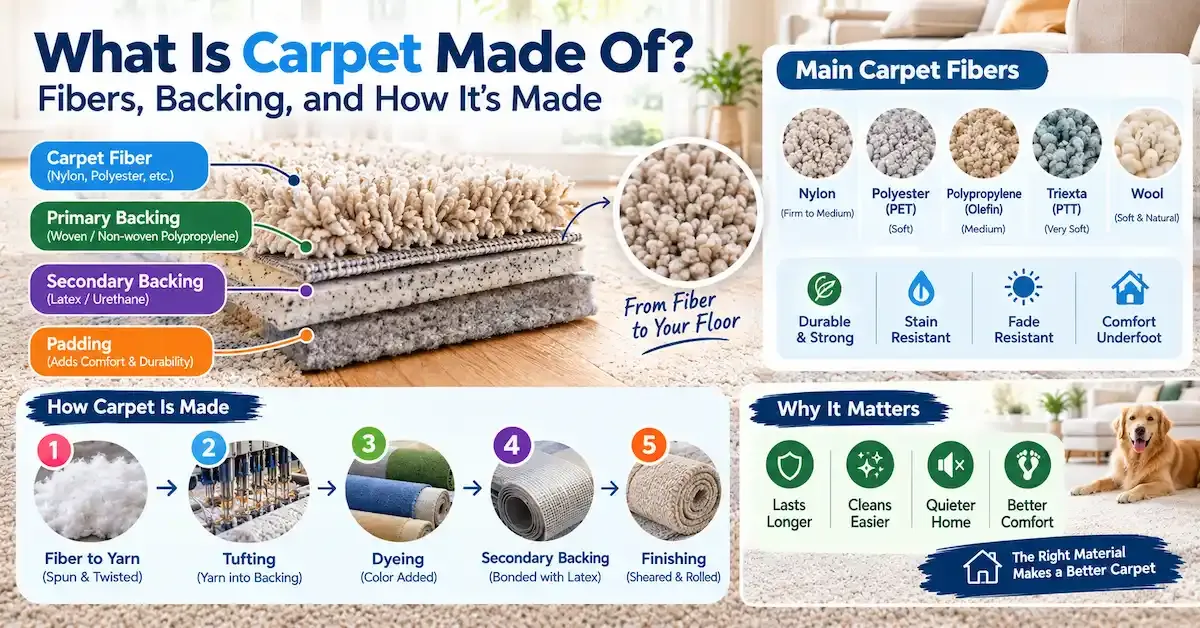
The Short Answer: Carpet is made of fiber strands tufted into a woven primary backing, bonded to a secondary backing with latex, and installed over a padding layer. Most residential carpet today uses synthetic fiber, most commonly nylon, polyester, or polypropylene. Over 90 percent of carpet sold in the U.S. is made from synthetic materials, according to the World Floor Covering Association.
Carpet Fiber at a Glance
| Fiber | Feel | Durability | Stain Resistance | Cost |
|---|---|---|---|---|
| Nylon | Firm to medium | Highest | Good with treatment | Medium-high |
| Polyester (PET) | Soft | Moderate | Good for water-based | Medium |
| Polypropylene (Olefin) | Medium | Low to moderate | Excellent for water | Low |
| Triexta (PTT) | Very soft | Good | Built-in, permanent | Medium |
| Wool | Soft, natural | High | Natural oil resistance | High |
What Is Carpet Made Of?
What is carpet made of at the fiber level depends on which material was chosen before the yarn was spun. Most carpet starts as either staple fiber (short strands twisted together, common in polyester and wool) or bulk continuous filament, called BCF (a single unbroken strand, used in nylon and polypropylene). BCF sheds less after installation. Staple fiber may shed in the first few months before settling.
The five main fibers:
Nylon dominates the market. It resists crushing under heavy traffic, holds dye well, and when treated resists stains. Nylon 6,6 offers better heat and abrasion resistance than nylon 6.
Polyester (PET) is soft and color-rich, often made from recycled plastic bottles. It resists water-based stains naturally but mats faster than nylon under heavy use.
Polypropylene (olefin) is hydrophobic, resists moisture and UV fading, and is the most affordable option. Its weakness is oil absorption, making it a poor choice near kitchens.
Triexta (PTT), sold as Sorona and marketed by Mohawk as SmartStrand, has stain resistance built into the fiber rather than applied as a coating. Up to 37 percent of its structure comes from corn glucose.
Wool is the only major natural fiber used in carpet. It resists soil through its natural lanolin content and biodegrades at end of life, but costs two to three times more than comparable synthetic options.
How Carpet Is Made Step by Step
Making carpet starts long before the tufting machine. Here is the full sequence.
Step 1: Fiber to yarn. Loose fiber strands called staples are loaded into a hopper, heated, lubricated, and formed into rope-like slivers. Slivers are drawn out and twisted into yarn, wound onto spools.
Step 2: Tufting. The yarn feeds into a tufting machine that runs up to 12 feet wide with over 1,200 needles, according to HowStuffWorks. Each needle pushes yarn through the primary backing while a looper underneath holds each loop in place. If blades cut those loops, the result is cut pile. Left uncut, it becomes loop pile.
Step 3: Dyeing. Color is applied at this stage using one of three methods, covered below.
Step 4: Secondary backing. A secondary backing is bonded to the primary backing using latex or urethane, sealing the yarn and adding dimensional stability.
Step 5: Finishing. The face is sheared for even height, inspected, and rolled for shipping. Standard residential carpet typically takes 24 to 48 hours from raw fiber to finished roll.
How Carpet Is Dyed and Why the Method Matters
Three main dyeing methods are used, each producing different results in real homes.
Yarn dyeing applies color before tufting. Color penetrates deeply, producing strong consistency and fade resistance.
Beck dyeing boils finished carpet in large dye vats after tufting. It creates rich color variation in patterned carpet but color sits more on the fiber surface.
Continuous dyeing applies dye to moving carpet on a production line. Fast and cost-effective, but color depth is less consistent than yarn dyeing.
Solution dyeing is a separate process where color is blended into the liquid fiber before it hardens into filament. Color runs through the entire strand. A family with solution-dyed nylon in a south-facing living room found the color unchanged after seven years. A neighbor's continuous-dyed polyester in the same sun exposure had visibly faded by year three.
What Is Carpet Backing Made Of?
Carpet backing is a two-layer system. Most buyers never see it, but it determines how stable the carpet is once installed.
Primary backing: Almost always woven or non-woven polypropylene. The tufted yarn passes through this layer, which holds the loops or cuts in place during manufacturing.
Secondary backing: Bonded to the primary backing using SBR (styrene-butadiene rubber) latex or urethane. This layer adds dimensional stability, prevents the carpet from stretching or shrinking, and makes installation easier. A homeowner who bought budget carpet with poorly bonded secondary backing found the carpet buckling in two years when the latex layer separated under normal foot traffic.
Some higher-end carpet uses a unitary backing system instead, applying a thick layer of urethane directly to the primary backing and combining both layers into one.
Why 70 Percent of U.S. Carpet Comes From One Town
More than 1 billion square feet of carpet is produced in the U.S. each year, and roughly 70 percent of it comes from Dalton, Georgia, according to HowStuffWorks. Dalton earned the title "Carpet Capital of the World" from a cottage industry making tufted bedspreads in the early 1900s. When bedspread machines were adapted for carpet in the 1950s, Dalton's infrastructure was already in place. Mohawk, Shaw, and Dixie all operate manufacturing facilities in and around the city.
The environmental scale of that production is significant. According to the EPA, more than 4 billion pounds of carpet enter the U.S. solid waste stream every year, with only about 9 percent recycled. The rest, including fiber, latex backing, and padding, ends up in landfills.
Common Questions, Answered
What are carpets made out of in most homes today?
+
What are carpets made out of in the average home? Mostly nylon, polyester, or polypropylene. Nylon is most common in higher-quality residential carpet. Polyester and polypropylene dominate budget and mid-range lines.
What is BCF yarn in carpet?
+
BCF stands for bulk continuous filament. It is a single unbroken strand of fiber wound into yarn without joining short pieces. BCF carpet sheds significantly less than staple fiber carpet after installation.
What is staple fiber carpet and how is it different from BCF?
+
Staple fiber is made from short pieces twisted together, common in polyester and wool. Expect some shedding in the first months that tapers off. BCF sheds less but costs more to produce.
What is the primary backing of carpet made of?
+
Almost always woven or non-woven polypropylene. It is the mesh material the yarn gets tufted through. It holds fiber loops in place until the secondary backing is bonded on.
Why do some carpets have secondary backing and others don't?
+
Most residential carpet has a secondary backing bonded with latex or urethane for dimensional stability. Some higher-end carpet uses a unitary backing system instead, combining both layers into one thicker application.
What is solution-dyed carpet?
+
Solution-dyed carpet has color added to the fiber while still in liquid form, before it hardens into filament. Color runs through the entire strand, making it far more resistant to fading and bleaching than surface-dyed carpet.
How long does the carpet manufacturing process take?
+
Standard residential carpet typically takes 24 to 48 hours from raw fiber to finished roll once the production line is running. Custom colors or specialty backing can extend that timeline.
What does "tufted" mean on a carpet label?
+
Tufted means the fiber was pushed through a backing material using needles, the method used for almost all residential carpet today. The alternative is woven carpet, where pile and backing are created simultaneously on a loom at higher cost.
Is carpet backing toxic?
+
SBR latex used in most secondary backing is considered low-risk under normal indoor conditions. Look for CRI Green Label Plus certification, which tests carpet systems including backing for VOC emissions at levels recognized by the EPA and the American Lung Association.
What is carpet made of, summed up simply: it starts as loose fiber, gets twisted into yarn, tufted into polypropylene backing, dyed, bonded to a secondary backing, and rolled out to be installed over padding. Knowing that sequence tells you what questions to ask when a label says nylon BCF versus staple polyester, and why solution-dyed fiber in a sunny room is a genuinely different product than continuously dyed fiber.
If you are in the Las Cruces NM area and need help cleaning or maintaining your carpet, our team is ready to help.

Michael Sanders
Michael Sanders is a home care and cleaning industry writer covering carpet maintenance, flooring care, and household cleaning practices across the United States. His work focuses on practical, research-backed guidance — from stain and odor removal to deep extraction methods and indoor allergen prevention. Michael collaborates with cleaning professionals to ensure accuracy, and his writing reflects a genuine interest in helping homeowners make informed decisions about caring for their homes.
Curious What's Actually in Your Carpet?
Whatever fiber or backing your carpet uses, our team knows how to clean it right. Serving Las Cruces, NM and the surrounding areas.
Call Now — Free Quote