

Blog · Carpet Materials
What Is Carpet Padding? Types, Thickness, and What It's Made Of
What is carpet padding and why does it matter more than most homeowners realize? You can spend two thousand dollars on carpet and wear it out in three years by pairing it with the wrong pad or no pad at all. The padding is invisible once installed, which is exactly why it gets overlooked.
Published October 7, 20269 min read
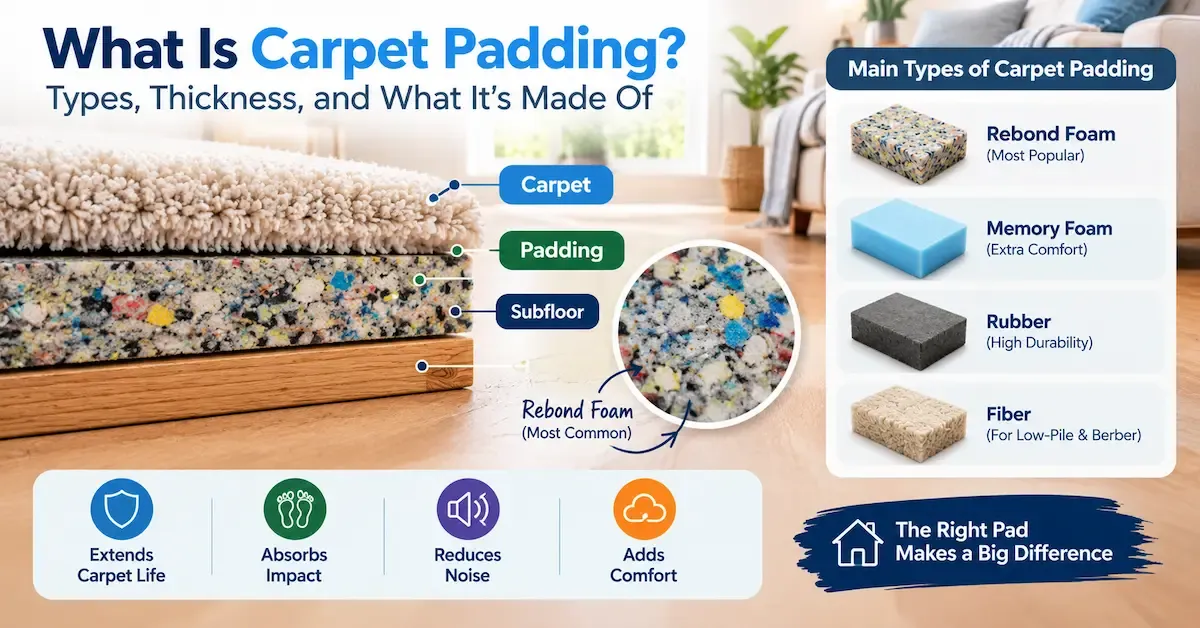
This guide breaks down what carpet padding does, what it is made of, how the main types compare, and what the density and thickness numbers on the label really mean.
The Short Answer: Carpet padding is a layer of foam, rubber, or fiber material installed between your carpet and the subfloor. It absorbs foot traffic impact, extends carpet life, reduces noise, and adds comfort underfoot. The right pad depends on your carpet type, room traffic, and whether moisture is a factor.
Carpet Padding at a Glance
| Factor | Detail |
|---|---|
| Also Called | Carpet underlayment, carpet cushion, carpet underlay |
| Main Materials | Rebond foam, rubber, memory foam, frothed foam, fiber |
| Standard Thickness | 7/16 inch for most cut pile; 3/8 inch or less for Berber |
| Standard Density | 6 to 8 lb for residential; 8 to 10 lb for high traffic |
| Cost Range | $0.50 to $2.00 per square foot for material |
What Is Carpet Padding and Why Does It Matter?
Carpet padding is the layer that sits between the bottom of your carpet and the surface of your subfloor. Without padding, carpet backing grinds against bare subfloor with every footstep. That friction breaks down the backing and the fiber attachment points over time, causing the carpet to look worn and feel flat years before it should. A quality pad absorbs that impact instead, letting carpet fibers recover their shape between steps.
Three scenarios show how much this matters. A homeowner installs plush carpet with free prime foam from the retailer, and within two years the carpet feels flat because the foam collapsed and stopped absorbing impact. A second homeowner buys the same carpet with an 8 lb rebond pad and the carpet still looks new at year seven. A family with pets chooses a moisture barrier rebond pad, and when a pet accident happens, the liquid stays above the pad long enough to clean up before reaching the subfloor. The padding made the difference in all three cases.
What Is Carpet Padding Made Of?
It depends on the type, but most residential padding falls into three material categories: polyurethane foam, rubber, and fiber.
Polyurethane foam is the most common and includes rebond foam, prime foam, frothed foam, and memory foam. Rebond foam, also called bonded urethane, is made from scrap and off-cut pieces left over from prime foam manufacturing. Those pieces are bonded together using heat and pressure, which is why the cross-section looks multicolored. Rebond is the most widely used carpet padding type in the United States.
Rubber padding comes as slab rubber, which is dense and flat and can survive multiple carpet replacements, or waffle rubber, which has a textured surface that allows heat to pass through and suits radiant heat flooring.
Fiber padding is made from synthetic materials like nylon or polyester, or natural materials like jute or felt. It is flat and firm rather than cushioned, suited to low-pile and looped carpet styles that need a stable base rather than softness.
Carpet Padding Types Explained
The seven main carpet padding types have different constructions, performance levels, and use cases. Here is how they compare.
| Type | Made From | Durability | Best For | Watch Out For |
|---|---|---|---|---|
| Rebond Foam | Recycled urethane scraps | Good to very good | Most residential carpet | Lower grades wear fast |
| Memory Foam | Viscoelastic foam | Moderate | Bedrooms, low traffic | Collapses under heavy use |
| Prime Foam | Virgin polyurethane | Low | Temporary, unused rooms | Often free with cheap carpet, rarely worth it |
| Frothed Foam | Dense polyurethane | Excellent | Long-term installs, heavy traffic | Higher cost, less common in retail |
| Slab Rubber | Natural or synthetic rubber | Excellent | Stairs, heavy traffic, concrete | Expensive, heavy to install |
| Waffle Rubber | Rubber with textured surface | Good | Radiant heat floors | Less durable than slab |
| Fiber | Synthetic or natural fibers | Good | Berber, low pile, commercial | Firm, not cushioned |
For most households, rebond foam at 8 lb density is the right starting point. Memory foam suits a bedroom where comfort is the priority and traffic is light. For anything on concrete, a slab rubber or moisture barrier rebond pad is the safer choice. The Healthier Choice brand offers CRI Green Label Plus certified padding for households concerned about indoor air quality and VOC emissions.
Carpet Padding Density and Thickness: The Numbers That Actually Matter
Most homeowners are never told what the numbers on a carpet pad label mean. Density and thickness predict real-world performance, and they are not the same thing.
Density is measured in pounds per cubic foot and tells you how much material is packed into the pad. Higher density means more support and longer lifespan. Thickness is simply how tall the pad is in inches.
| Specification | What It Means | Guideline |
|---|---|---|
| 6 lb density | Softer, less supportive | Low-traffic rooms, guest bedrooms only |
| 8 lb density | Balanced support and comfort | Most residential carpet, recommended starting point |
| 10 lb density | Firm, maximum support | Stairs, hallways, heavy traffic areas |
| 7/16 inch thick | Standard for cut pile carpet | Plush, Saxony, textured, frieze |
| 3/8 inch thick | Firmer, correct for loops | Berber, low pile, commercial |
| 1/2 inch thick | Very plush, not recommended | Causes rippling in most carpet types |
The 6 lb vs 8 lb difference matters more than most buyers realize: 6 lb pads typically last 6 to 10 years, while 8 lb pads last 10 to 20 years, according to experience reported across multiple flooring industry sources. The cost difference between the two is small.
One mistake that causes real damage is going too thick. A homeowner installs memory foam padding under Berber because it feels luxurious in the store, and the carpet develops visible waves within the first year. The soft pad gives too much under the tight Berber loops, stressing the carpet backing until it buckles.
How to Match Carpet Padding to Your Carpet Type
Different carpet constructions need different pad characteristics. Using the wrong combination is one of the most common carpet installation mistakes.
Plush and cut pile carpet, including Saxony, textured, and frieze styles, pair best with a 7/16 inch rebond or frothed foam pad at 8 lb density. These carpets have upright fibers that benefit from support and cushion.
Berber and low pile carpet need a thin, firm pad at 3/8 inch or less. Flat fiber padding or thin rubber are the correct choices here. A soft pad allows tight Berber loops to flex too much, stressing the backing and accelerating loop damage.
Carpet on concrete subfloors needs either a moisture barrier rebond pad or a rubber pad that resists mold and vapor. Standard foam on a concrete slab can trap moisture and develop mildew. The CRI recommends checking your carpet manufacturer's warranty for specific padding requirements, since some warranties are voided by non-compliant padding.
What Good Carpet Padding Does to Your Carpet's Lifespan
The CRI notes that carpet padding absorbs a significant portion of the impact from foot traffic, reducing stress on carpet fibers and backing with every step. That absorbed impact is the primary reason carpet wears out: fibers bend, backing breaks, and tuft bind weakens when padding has failed or was never adequate.
A carpet installed over quality 8 lb rebond padding typically lasts 10 to 20 years in moderate residential use. The same carpet over inadequate prime foam may show wear in 3 to 5 years under the same conditions. The padding does not just make carpet feel better. It determines how long the carpet survives.
The CRI Green Label Plus program certifies carpet cushion products for low VOC emissions. This certification is worth asking about when choosing padding for bedrooms or spaces where children spend time on the floor.
Common Questions, Answered
Does carpet padding have fiberglass?
+
Most modern carpet padding does not contain fiberglass. Standard foam, rubber, and fiber pads sold today are fiberglass-free. If you have concerns about a specific product, check the manufacturer's safety data sheet before purchasing.
Does carpet need padding or can you skip it?
+
Skipping padding is not recommended and voids most carpet warranties. Without it, carpet backs grind directly against the subfloor, breaking down the backing and fiber attachment far faster than normal wear would.
What carpet padding should I get for a bedroom?
+
An 8 lb rebond at 7/16 inch thickness is the practical choice. Memory foam is an option if comfort is the top priority and the room sees minimal traffic, but it compresses over time and costs more.
Is memory foam carpet pad worth the extra cost?
+
In a bedroom or low-traffic room, yes. Memory foam feels noticeably softer underfoot. In hallways, living rooms, or any busy space, it is not worth it because it compresses under repeated use.
What is the difference between carpet padding and a rug pad?
+
Carpet padding goes under wall-to-wall broadloom carpet and is stapled or taped to the subfloor. Rug pads go under moveable area rugs to prevent sliding and add cushion. They are different products and not interchangeable.
Can you reuse old carpet padding?
+
Generally no. Old padding loses its structure, compresses permanently, and can harbor allergens, pet odors, and moisture. New padding with new carpet is always the correct approach.
What is the best carpet padding for pets?
+
A moisture barrier rebond pad. The barrier prevents urine and liquid accidents from soaking through to the subfloor, giving you time to clean before damage occurs.
Is 8 lb carpet padding good for most homes?
+
Yes. An 8 lb density pad is the recommended starting point for most residential carpet with normal to moderate foot traffic. It balances comfort, support, and longevity without the extra cost of 10 lb commercial-grade padding.
What is a Karastan carpet pad?
+
Karastan is a premium carpet brand that manufactures its own branded padding lines designed to pair with Karastan carpet. Using a Karastan pad is sometimes required to keep the carpet warranty valid.
How much does carpet padding cost per square foot?
+
Standard rebond runs $0.50 to $1.00 per square foot. Memory foam and frothed foam run $1.00 to $1.50. Premium rubber runs $1.50 to $2.00 or more. Installation labor adds $0.50 to $1.00 per square foot on top.
What is carpet padding, in the end? It is the part of the flooring system nobody sees but everyone walks on, and it determines how long the carpet above it actually lasts. Choosing the right density, thickness, and material for your specific carpet and room is a decision that affects your floor for the next decade.
If you are in the Las Cruces NM area and need professional help with carpet cleaning or maintenance, our team is ready to help.

Michael Sanders
Michael Sanders is a home care and cleaning industry writer covering carpet maintenance, flooring care, and household cleaning practices across the United States. His work focuses on practical, research-backed guidance — from stain and odor removal to deep extraction methods and indoor allergen prevention. Michael collaborates with cleaning professionals to ensure accuracy, and his writing reflects a genuine interest in helping homeowners make informed decisions about caring for their homes.
Already Have Carpet? Keep It Lasting Longer
Good padding only gets you so far — regular professional cleaning protects the investment above it. Serving Las Cruces, NM and the surrounding areas.
Call Now — Free Quote