

Blog · Carpet Education
How to Choose Carpet: Fiber, Weight, and What to Skip
Knowing how to choose carpet sounds simple until you're standing in a showroom staring at 200 samples with no idea what separates a carpet that lasts 15 years from one that looks tired in 18 months. Most buyers focus on color and feel, then wonder why the carpet they loved in the store looks flat and worn two years later.
Published October 11, 202613 min read
This guide gives you the exact decision sequence, the specs that actually matter, and the numbers to use when comparing options.
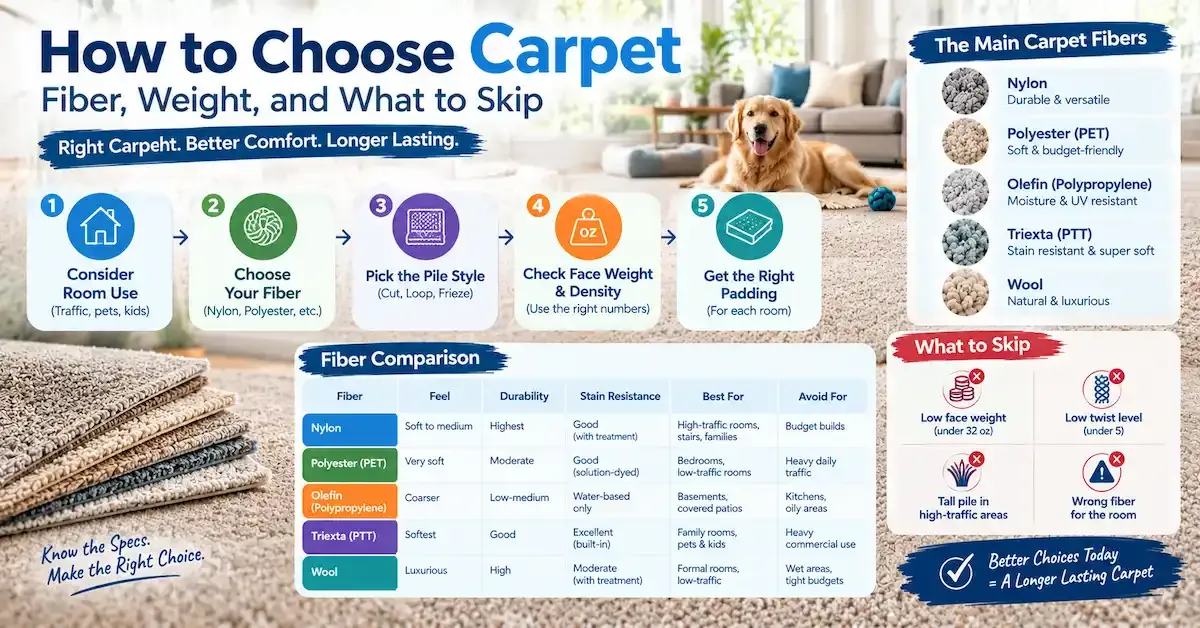
Start with how the room gets used, not with color or feel. Then choose your fiber based on traffic and lifestyle. Then pick your pile style. Then check face weight and density against the numbers in this guide. Get the padding right last. In that order, how to choose carpet becomes a straightforward process instead of a guessing game.
Start Here — The Order Most Buyers Get Wrong
When most people think about how to choose carpet, they start with color or texture. That's the wrong starting point.
The right sequence is this: room use first, fiber second, pile style third, face weight and density fourth, padding fifth. Every decision in the sequence narrows your options so the next decision is easier.
Room use means asking how much foot traffic the space gets, whether pets or children are involved, and whether the room is below grade (basement) or above. A bedroom and a main hallway have almost nothing in common when it comes to carpet requirements, even if the same carpet can technically be installed in both.
A homeowner who skips this sequence and chooses a plush Saxony carpet for a main hallway because it felt soft in the store will see crushing, traffic lanes, and permanent pile distortion within 6 to 12 months. The carpet was not defective. It was simply the wrong product for that use.
Work through the sequence and every other decision becomes easier to make.
Which Carpet Fiber Should You Choose?
Fiber is the single biggest factor in how carpet performs over time. Here is a practical comparison for real buying decisions.
Carpet Fiber Comparison
| Fiber | Feel | Durability | Stain Resistance | Best For | Avoid For |
|---|---|---|---|---|---|
| Nylon | Soft to medium | Highest | Good (topical coating) | High-traffic rooms, stairs, families | Budget builds |
| Polyester (PET) | Very soft | Moderate | Good (solution-dyed) | Bedrooms, low-traffic rooms | Heavy daily traffic |
| Olefin (Polypropylene) | Coarser | Low-medium | Water-based stains only | Basements, covered patios | Kitchens, oily environments |
| Wool | Luxurious | High | Moderate (needs treatment) | Formal rooms, low-traffic areas | Wet environments, tight budgets |
| Triexta (PTT) | Softest | Good | Excellent (built-in) | Families with pets and kids | Heavy commercial use |
Nylon remains the most proven fiber for homes with real daily use. Triexta (sold mainly as SmartStrand by Mohawk) challenges nylon on softness and built-in stain resistance but has a shorter performance track record. Polyester works well in bedrooms where softness matters more than crush resistance.
What Does Face Weight Mean — and What Numbers Actually Matter?
Face weight is the weight of the carpet fiber itself, measured in ounces per square yard. It does not include the backing. Higher face weight generally means more fiber per square yard, which means a denser, more durable surface.
Most buyers hear "higher is better" and stop there. The number only matters in context of where the carpet is going.
Face Weight Guide by Room
| Room or Area | Recommended Face Weight | Notes |
|---|---|---|
| Bedroom | 32 to 40 oz | Light traffic, softness priority |
| Living Room | 40 to 50 oz | Moderate daily traffic |
| Dining Room | 40 to 50 oz | Spill risk, moderate traffic |
| Hallways | 50 oz minimum | Constant directional traffic |
| Stairs | 50 to 60 oz | Highest wear point in any home |
| Basement | 28 to 40 oz | Moisture risk matters more here |
A carpet rated at 60 oz face weight sounds impressive, but if the twist level is low and the fiber is a cheap polyester blend, it will still crush and mat. Face weight tells part of the story. Twist level tells the rest.
Twist level is the number of times the yarn twists per inch. Look for a minimum of 5 to 6 twists per inch for any high-use area. The tighter the twist and the more heat-set the fiber, the better the carpet holds its appearance under foot traffic.
What Should I Look for When Buying Carpet for High-Traffic Rooms?
For high-traffic areas, what to look for when buying carpet comes down to three specs working together: face weight, twist level, and pile height.
Low pile carpet (under 3/4 inch) holds up better in high-traffic rooms than tall pile. Shorter fibers have less surface area to bend, mat, and lose their shape. Berber and level-loop constructions perform well in high-traffic zones for the same reason — the loop structure resists crushing.
A family with two kids and a dog who installs a long-pile, low-twist frieze carpet in their main living room will likely see permanent traffic lanes within 18 months. The carpet looked great on the showroom floor. In that home, in that room, it was the wrong spec.
For stairs specifically, look for: face weight at 50 oz or above, twist level of 6 or higher, and a short to medium pile height. Pattern carpets can hide wear on stairs better than solid colors. Avoid loop pile on stairs — a snag from a shoe or pet claw can unravel an entire row.
How to Choose Carpet Color Without Regretting It
Carpet color is where most buyers rely on gut feeling and get burned. A few facts change the entire decision.
First, carpet looks different under store lighting than it does under the natural light in your home. Always request a sample and place it in the actual room at different times of day before committing.
Second, what actually hides dirt is not what most people assume. Many buyers go dark, thinking it hides dirt. In reality, mid-tone colors in the tan, warm gray, and greige range hide everyday dirt, dust, and pet hair far better than very dark or very light shades. Very dark carpet shows dust and light pet hair constantly. Very light carpet shows every footprint and stain.
Carpet Color vs Traffic and Maintenance Reality
| Color Range | Hides Dirt | Hides Footprints | Hides Pet Hair | Best For |
|---|---|---|---|---|
| Light (cream, white, pale gray) | Poor | Poor | Poor | Formal low-traffic rooms only |
| Mid-tone (tan, greige, warm gray) | Best | Good | Good | Any room, any traffic level |
| Dark (charcoal, navy, espresso) | Poor (shows dust) | Good | Poor (shows light hair) | Accent areas, low-traffic rooms |
| Pattern or texture | Best overall | Best overall | Best overall | High-traffic, family homes |
Third, patterns and textured surfaces hide wear better than solid colors. A carpet that shows a subtle pattern or texture variation will maintain its appearance longer in busy rooms than a solid-color plush surface.
What Carpet Is Best for Bedrooms vs Living Rooms?
Different rooms have different requirements. Here is a practical room-by-room reference as part of a complete carpet buying guide.
Room-by-Room Carpet Picks
| Room | Best Fiber | Best Pile | Face Weight | Padding Priority |
|---|---|---|---|---|
| Bedroom | Polyester or triexta | Plush or Saxony | 32 to 40 oz | Comfort (thicker pad fine) |
| Living Room | Nylon or triexta | Textured cut pile | 40 to 50 oz | Density (firm pad) |
| Hallways | Nylon | Low cut pile or level loop | 50 oz minimum | Dense and thin pad |
| Stairs | Nylon | Low cut pile | 50 to 60 oz | Thin, dense pad only |
| Basement | Olefin or triexta | Level loop or low cut | 28 to 40 oz | Moisture-resistant pad |
Bedrooms are the one place where softness genuinely should drive the decision. Low traffic means lower face weight requirements, so you can put that budget toward a softer fiber or thicker pad for underfoot comfort.
Living rooms need a textured or cut pile surface rather than a smooth plush surface. Textured cut pile hides footprints and daily wear far better than a smooth Saxony in a room that sees constant use.
How Do You Know a Carpet Is Good Quality Before You Buy It?
A carpet buying guide that doesn't teach you how to evaluate quality in the store is incomplete. Here are four real tests.
The Bend Test: Fold a carpet sample in half, backing outward, so the face fibers are on the outside of the bend. If you can see a lot of the backing through the fibers, the carpet is low-density. Dense, quality carpet shows very little backing when bent.
The Twist Check: Look at the individual yarn tufts at eye level. Well-made carpet has tightly twisted, heat-set fibers with clear, distinct tips. Loosely twisted fibers with fraying tips will bloom and mat quickly under traffic.
The Backing Feel: Press your palm flat against the backing. Quality primary and secondary backing feels firm, consistent, and tightly bonded. Backing that feels thin, papery, or separating at the edges will delaminate under use.
The Texture Retention Warranty: Ask the retailer specifically for the texture retention warranty, separate from the general wear warranty. A manufacturer confident in their product backs it with a texture retention guarantee. If none exists, that tells you something about how the fiber and construction will hold up.
Two carpets can look and feel nearly identical in a showroom and perform completely differently at the three-year mark. The difference almost always comes down to twist level and backing quality — two things you can evaluate yourself before purchasing.
What Carpet Problems and Indoor Air Quality Tell You About Your Purchase
Carpet selection affects more than floor appearance. These facts are worth knowing before you buy.
According to the Carpet and Rug Institute, carpet can trap up to one pound of dirt per square yard before it visually appears dirty. A carpet that looks clean may already be holding significant particulate load — which is why fiber type, pile height, and cleaning frequency all connect directly to the air quality in your home.
The EPA reports that indoor air can be two to five times more polluted than outdoor air. New carpet off-gasses VOCs (volatile organic compounds) during the first 24 to 72 hours after installation. Choosing carpet certified by Green Label Plus — the Carpet and Rug Institute's indoor air quality standard — keeps VOC emissions at the lowest verified level.
The World Floor Covering Association notes that carpet installed over proper cushioning lasts up to 50% longer than carpet on poor or missing padding. The padding is not an upsell — it is the single biggest factor in how long your carpet investment performs.
The IICRC recommends professional carpet cleaning every 12 to 18 months for most households. Homes with pets, children, or allergy sufferers should clean more frequently. Regular professional cleaning removes what vacuuming cannot reach, extending carpet life and maintaining indoor air quality.
Common Questions About Choosing Carpet, Answered
What is a good face weight for carpet?
+
For most homes, 40 oz per square yard is the practical minimum for any room that sees daily use. Bedrooms can go as low as 32 oz. Stairs and hallways should be 50 oz or above. Face weight alone does not determine quality — pair it with a twist level of at least 5 to 6 turns per inch.
What carpet fiber is the most durable?
+
Nylon is the most durable carpet fiber available for residential use. It resists crushing, holds its texture under heavy traffic, and responds well to cleaning. Triexta (SmartStrand) is a strong alternative with better built-in stain resistance, though it has fewer decades of real-world performance data than nylon.
What carpet is best for pets?
+
Triexta and solution-dyed nylon are the top choices for pet households. Both offer strong stain resistance. Triexta's built-in resistance means it does not rely on a topical coating that wears off over time. Avoid loop pile constructions — pet claws can snag and unravel loops.
How thick should carpet padding be?
+
For most residential carpet, 7/16 inch thickness with a density of 6 to 8 pounds per cubic foot is the standard recommendation from the Carpet and Rug Institute. Berber and loop pile carpets need thinner, firmer padding — no more than 3/8 inch. Thicker is not always better; overly thick padding under a cut pile carpet can actually accelerate fiber breakdown.
What carpet pile is easiest to clean?
+
Low pile and level loop carpet are the easiest to clean. Shorter fibers mean less surface area for dirt and debris to cling to, and a vacuum reaches the base of the fiber more effectively. High pile and shag constructions trap more particulates and require more aggressive cleaning to maintain.
How much does new carpet cost per square foot installed?
+
Material costs range from roughly $1 to $2 per square foot for olefin entry-level options up to $7 to $9 per square foot for quality nylon or wool. Add padding at $0.50 to $1.50 per square foot and professional installation at $1 to $2 per square foot. A realistic total for a mid-grade nylon carpet with padding and installation runs $4 to $7 per square foot all in.
What are the most common mistakes people make when buying carpet?
+
The top four: choosing carpet before deciding on use requirements, skimping on padding, ignoring twist level and focusing only on face weight, and not requesting a sample to view in the actual room before buying.
Does carpet color make a room look bigger or smaller?
+
Light-colored carpet makes a room feel larger and more open. Dark carpet makes a space feel cozier and more enclosed. Mid-tone carpet in warm neutrals has the least visual impact on perceived room size, making it the most flexible choice for most rooms.
What is carpet density and how is it different from face weight?
+
Face weight measures how much fiber is in the carpet by weight. Density measures how tightly those fibers are packed together. A carpet can have high face weight but low density if the tufts are spread far apart. Both specs matter. The formula: density equals face weight multiplied by 36, divided by pile height in inches.
How long does carpet typically last?
+
Quality nylon carpet with proper padding and regular professional cleaning lasts 15 to 25 years in moderate-traffic areas. Polyester averages 10 to 15 years. Olefin typically runs 5 to 10 years in residential use. Wool can last 25 to 50 years with proper care. Lifespan depends heavily on traffic level, padding quality, and cleaning frequency.
The detail most buyers overlook entirely is the combination of three specs working together: face weight at the right number for that specific room, twist level at 5 or more turns per inch, and a texture retention warranty from the manufacturer. When all three line up, you have a carpet built to hold its appearance for years. When even one is missing, the other two cannot compensate. That combination — not price, not feel in the store — is what separates carpet that looks good at year ten from carpet that looks tired at year two.
If you are in the Las Cruces NM area and need professional carpet cleaning or guidance on caring for your carpet investment, our team at Bliss Carpet Cleaning is ready to help.

Michael Sanders
Michael Sanders is a home care and cleaning industry writer covering carpet maintenance, flooring care, and household cleaning practices across the United States. His work focuses on practical, research-backed guidance — from stain and odor removal to deep extraction methods and indoor allergen prevention. Michael collaborates with cleaning professionals to ensure accuracy, and his writing reflects a genuine interest in helping homeowners make informed decisions about caring for their homes.

Already Chose Your Carpet? Protect That Investment.
Whatever fiber or pile you picked, our team knows how to keep it looking new for years. Serving Las Cruces, NM and the surrounding areas.
Call Now — Free Quote