

Blog · Carpet Materials
Plush vs Frieze Carpet: Which Style Fits Your Home?
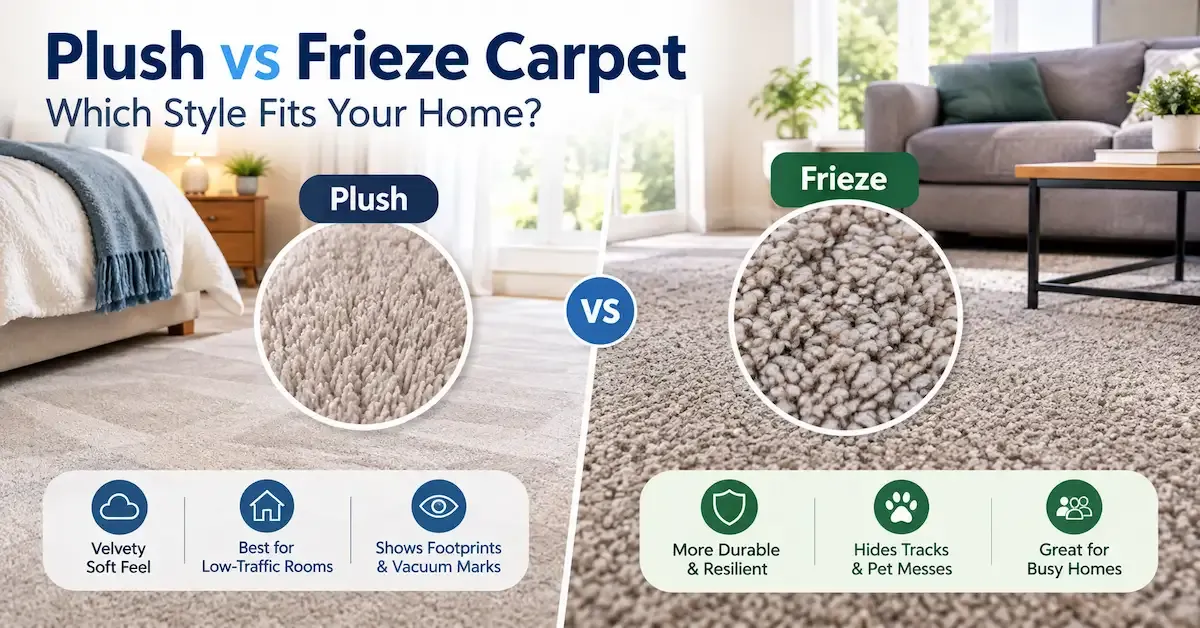
Plush vs frieze carpet is a comparison most homeowners face without realizing how different these two carpet styles actually are. Both are cut pile, both feel soft underfoot, and both come in similar neutral tones. The real differences show up after six months of daily use, when one holds its look and the other starts showing every footprint.
Published October 6, 20269 min read
This guide explains what is a plush carpet, what makes frieze distinct, which rooms each belongs in, what pile reversal means for plush owners, and what both cost in real numbers.
The Short Answer: Plush carpet has evenly sheared, upright fibers that create a smooth velvety surface. Frieze carpet has tightly twisted, crimped fibers that curl sideways. Plush wins on elegance in low-traffic rooms. Frieze wins on durability and track-hiding in busy spaces.
Plush vs Frieze Carpet at a Glance
| Factor | Plush | Frieze |
|---|---|---|
| Construction | Fibers cut uniform, stand upright | Fibers heat-set, twisted, curl sideways |
| Feel Underfoot | Very soft, cushioned, velvety | Soft but textured, casual feel |
| Footprint Visibility | High, shows every step and vacuum mark | Low, crimped fibers rebound quickly |
| Durability | Moderate, crushes under heavy traffic | Higher, twisted fiber resists matting |
| Stain Resistance | Good with treatment | Good, PET fiber versions naturally resistant |
| Seam Visibility | Noticeable, especially in tight plush | Less noticeable, texture hides seams |
| Best Rooms | Bedrooms, formal rooms, low traffic | Hallways, living rooms, stairs, busy homes |
| Cost Range | $2 to $7 per sq ft material | $3 to $8 per sq ft material |
What Is a Plush Carpet?
It is a cut pile style where yarn loops are sheared evenly, leaving fiber tips standing upright at a uniform height. That flat-cut surface gives plush its velvet-smooth look and luxurious feel underfoot.
The evenness of the cut is also plush's main weakness. When fibers all point the same direction, footsteps and vacuuming push them slightly off-angle, changing how they reflect light. Footprints and vacuum lines become clearly visible.
Plush cut pile comes in several density levels. Dense, tightly packed plush holds up better than loosely constructed versions. Nylon plush resists staining and crushing better than polyester plush, which mats faster in high-traffic spots.
What Is Frieze Carpet?
It is a cut pile style where the yarn is twisted very tightly and then heat-set before cutting, locking the twist into the fiber permanently. That locked twist causes the fiber tips to curl sideways instead of standing upright, giving frieze its textured, slightly tousled look.
The heat-setting step is what separates frieze pile carpet from plush. Because the fibers lie at an angle rather than standing straight up, foot traffic presses them sideways and distributes weight across the strand instead of crushing the tip. This is why frieze handles traffic better and bounces back where plush stays flat.
Nylon frieze carpet is the most durable version. PET recycled polyester frieze offers strong stain resistance at a lower price, making it practical for families with children or pets. Both are widely available from major manufacturers including Mohawk and Shaw.
Plush vs Frieze Carpet: Head-to-Head
Both styles start from the same cut pile construction. The heat-setting and twist level are what pull their performance apart over years of use.
| Factor | Plush | Frieze |
|---|---|---|
| Crush Resistance | Moderate, needs high face weight to hold up | High, sideways fiber naturally resists compression |
| Track and Footprint Visibility | High, especially in Saxony and tight plush | Low, crimped surface scatters light evenly |
| Pet Suitability | Good, no loop snag risk | Good, no loop snag risk |
| Stain Resistance | Good with protective treatment | PET versions naturally stain-resistant |
| Vacuuming | Standard vacuum fine, groom in one direction | Height-adjustable beater bar recommended |
| Seam Visibility | More visible, especially in formal rooms | Less visible, texture conceals seams well |
| Repair Ease | Moderate | Moderate |
What Causes Pile Reversal and Watermarking in Plush Carpet?
Pile reversal, also called watermarking or pooling, is the most common complaint plush carpet owners report, and the topic competitors almost universally skip.
It happens when sections of plush fiber lean in a different direction from the surrounding area, causing those sections to reflect light differently. The result looks like a water stain or shadowy patch, even when the carpet is completely clean. The CRI classifies this as an aesthetic characteristic rather than a defect, meaning it is not covered under most warranties.
Contributing factors include foot traffic patterns, furniture weight, humidity changes, and vacuuming direction. Frieze carpet does not develop pile reversal the same way because its crimped fibers naturally scatter light at multiple angles regardless of which direction they lean.
To reduce pile reversal in plush: vacuum in consistent strokes rather than random directions, use a quality underpad, and keep indoor humidity stable. In formal or low-traffic rooms, the risk stays manageable. In busy family rooms, it is nearly unavoidable over time.
Which Carpet Style Works Best in Each Room?
| Room | Best Pick | Why |
|---|---|---|
| Master bedroom | Plush | Low traffic, comfort priority, formal look |
| Guest bedroom | Either | Plush for elegance, frieze for easy upkeep |
| Living room | Frieze | Hides daily foot traffic, resists crushing |
| Hallways | Frieze | Constant traffic, needs bounce-back durability |
| Stairs | Frieze | Concentrated wear, seam visibility less of issue |
| Home office | Either | Frieze for busy use, plush for quiet formal space |
| Basement | Frieze with synthetic fiber | PET or nylon handles humidity better |
Frieze Carpet Cost vs Plush Carpet Cost
Frieze typically costs slightly more than plush because heat-setting requires running the yarn through an additional steam or dry heat chamber after twisting, adding an extra equipment pass, energy cost, and production time before the carpet is even cut. Plush skips that step entirely.
Plush carpet material commonly runs $2 to $7 per square foot, with budget polyester versions starting around $2 and quality nylon toward the higher end. Frieze carpet material runs $3 to $8 per square foot, according to cost data from Angi, with PET frieze at the lower end and nylon frieze toward the higher end.
Installation labor adds $1 to $4 per square foot for either style. For a 250 square foot bedroom, a plush project runs roughly $750 to $2,750 fully installed. A comparable frieze project runs $1,000 to $3,000. The difference is modest, and frieze's lower maintenance cost often offsets it over time.
Common Questions, Answered
Is frieze carpet the same as short shag carpet?
+
Essentially yes. Frieze is the modern version of shag carpet, updated with tighter twist levels and better fiber technology. Today's frieze looks cleaner and more refined than 1970s shag while keeping the same casual, textured character.
Does white frieze carpet show dirt more?
+
More than darker tones, but less than white plush. Frieze's crimped texture helps disguise surface soil between vacuuming sessions. In high-traffic areas, light-colored frieze needs vacuuming more frequently than neutral or darker shades.
What is nylon frieze carpet and is it worth the higher price?
+
Nylon frieze carpet offers better crush resistance, longer lifespan, and stronger stain resistance than PET versions. For hallways, stairs, and living rooms under heavy daily use, nylon frieze is worth the premium over polyester.
Can you find frieze area rugs?
+
Yes. Frieze area rugs are widely available and deliver the same track-hiding surface as wall-to-wall frieze. They work well in living rooms or dining areas where you want frieze's practical benefits without full room installation.
How does plush carpet compare to Berber?
+
Plush and Berber are opposite constructions. Plush is cut pile, soft, and shows tracks. Berber is loop pile, firm, and hides tracks but carries snag risk from pet claws. Plush suits comfort-focused rooms; Berber suits very high-traffic or commercial spaces.
What are the best frieze carpet brands?
+
Mohawk and Shaw are the two most widely available frieze brands in the U.S., both offering nylon and PET lines across multiple price points through major flooring retailers and independent dealers.
Is plush Berber carpet a real product?
+
Yes. Plush Berber refers to a carpet with Berber-style flecked coloring applied to a cut pile construction. It combines the Berber look with cut pile softness, though it lacks the loop-based durability of traditional Berber.
What colors does frieze carpet come in?
+
Frieze most commonly comes in neutrals including beige, gray, tan, brown, and charcoal, often with multi-color flecked yarns that help hide dirt. Bright or heavily saturated colors are rare in frieze.
Is low pile carpet the same as plush carpet?
+
Not exactly. Low pile describes pile height, while plush describes construction style. Plush can be low, medium, or higher pile. Low pile carpet can be plush, frieze, or loop construction.
How long does frieze carpet last compared to plush?
+
Quality nylon frieze in a busy family room typically lasts 10 to 15 years. Quality nylon plush in a low-traffic bedroom can match that, but in high-traffic areas plush shows age noticeably sooner than frieze.
Plush vs frieze carpet is ultimately a trade between elegance and endurance. Plush looks more refined in rooms where that matters. Frieze holds its look longer anywhere traffic or daily life is a real factor. The right answer depends less on which is objectively better and more on where the carpet is going and what that room actually demands.
If you are in the Las Cruces NM area and need help choosing or maintaining carpet in your home, our team is ready to help.

Michael Sanders
Michael Sanders is a home care and cleaning industry writer covering carpet maintenance, flooring care, and household cleaning practices across the United States. His work focuses on practical, research-backed guidance — from stain and odor removal to deep extraction methods and indoor allergen prevention. Michael collaborates with cleaning professionals to ensure accuracy, and his writing reflects a genuine interest in helping homeowners make informed decisions about caring for their homes.
Not Sure Which Carpet Style Is Right for You?
We clean and maintain every pile type the right way, from soft plush to durable frieze. Serving Las Cruces, NM and the surrounding areas.
Call Now — Free Quote